Cyngor Llyfrau Cymru
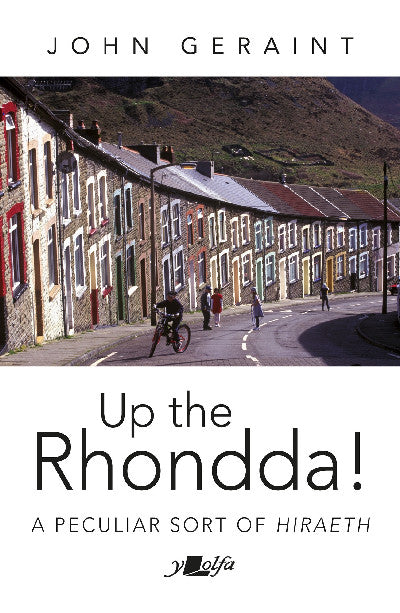
Up the Rhondda! — A Peculiar Sort of Hiraeth
Up the Rhondda! — A Peculiar Sort of Hiraeth
Couldn't load pickup availability
Disgrifiad Cymraeg / Welsh Description
Casgliad o 43 traethawd sy'n amlinellu'n llachar agweddau ar fywyd yn y Rhondda fel y bu ac fel y mae yn awr. Amlygir y newidiadau a fu yn yr ardal, y gwerthoedd a lywiodd fywydau pobl y Rhondda yn y gorffennol, a sut gall y gwerthoedd hynny lywio'r ardal eto - a Chymru gyfan - tuag at well dyfodol.
Disgrifiad Saesneg / English Description
In this kaleidoscopic portrait, John Geraint captures with a filmmaker's eye the exuberant life of this former mining community in changing times. Comic and evocative, the book shows how the values the valley has lived by could guide the Rhondda - and the wider world - towards a better future.
Dosbarthu
Byddwn yn dosbarthu eitemau sydd mewn stoc o fewn 3 diwrnod gwaith, fel arfer drwy Royal Mail Tracked 48. Ar gyfer archebion o flaen llaw, byddwn yn dosbarthu’r eitem o fewn 3 diwrnod gwaith ar ôl ei derbyn gan ein cyflenwr.
Dispatch
In-stock items will be dispatched within 3 business days, usually by Royal Mail Tracked 48. For pre-orders, we’ll dispatch within 3 business days of receiving the item from our supplier.
Manylion y cynnyrch / Product details
- ISBN 13
- 9781800994874
- Gwales Code
- gwales.com.9781800994874
- Gwerthwr / Vendor
- Cyngor Llyfrau Cymru
- Long Title
- Up the Rhondda! — A Peculiar Sort of Hiraeth
- Sub Title
- A Peculiar Sort of Hiraeth
- Awdur / Author
- Geraint, John
- Current Price ex VAT
- £9.99
- Current Price inc VAT
- £9.99
- Availability Status (EN)
- Available
- Availability Status (CY)
- Ar gael
- Dyddiad cyhoeddi / Publication Date
- 2023-11-11
- Cyhoeddwr / Publisher
- Y Lolfa
- Media Type (EN)
- Paperback / softback
- Media Type (CY)
- Clawr meddal
- Pages
- 240 pages
- Size
- 140 × 215 mm; depth 19 mm
- Language Code
- English
- Categori / Category
- CY: Hanes, Hanes Lleol, Arferion Gwlad, Llên Gwerin (yn Saesneg) | EN: History, Welsh Life and Customs, Local History, Folk Tales (in English)
Bywgraffiad yr Awdur / Author Biography
Multiple-BAFTA winner and recipient of a Royal Television Society award for his Outstanding Contribution to Television, Dr John Geraint is one of Wales' most experienced and successful documentary filmmakers. He has worked for major international broadcasters such as National Geographic, the History Channel and France Télévisions, as well as ITV, Channel 4, S4C and the BBC– for whom he directed the landmark history of the nation, 'The Story of Wales'. As Head of Production at BBC Wales, he led more than 400 programme-makers producing hundreds of hours of output each year. His 2001 film, 'Do Not Go Gentle', a celebration of Dylan Thomas’s great poem, was nominated for one of the world’s foremost media prizes, the Banff Rockies, alongside globally renowned programmes 'The West Wing', 'Blue Planet' and 'Band of Brothers'. He remains active as an Executive Producer, his most recent credit for the BBC being 'Wales: Who Do We Think We Are?' (2022). He has also held a number of public appointments, including membership of the Wales Employment and Skills Board; Trustee and Chair of Audit, Arts Council of Wales; Chair, Skillset Cymru National Board, overseeing the work in Wales of the Sector Skills Council for the Audio-Visual Industries; and Chair of the young people’s media charity, Zoom Cymru.
Adolygiad y Cyhoeddwr / Publisher Review
I was delighted when I was asked to review this book. The Rhondda is very close to my heart, as I spent many weekends there over many years as a teenager. A very able lady came to work in Carmarthen in the early 1960s and stayed with my parents who ran a bed and breakfast business. On most weekends she would go home to Treorchy to visit relatives, and quite often I would accompany her. I became very friendly with the boy next door to her relatives, and we played football together, climbed the coal tips of the Abergorky colliery, frequented the Station Café, better known as the local Bracchi , and shared several train trips to Ninian Park Halt to watch Cardiff City. Coincidentally the ‘boy next door’ was Phil George, a very good friend of the author, both of whom have pursued successful careers as accomplished film and documentary makers. Indeed, George receives several mentions in the text. The book comprises 43 talks given by the author in a series entitled John and the Rhondda , broadcast on local radio and available online. Some of these are based on films he produced which feature the subject matter in question, such as the aforementioned Italian café community. Many of the chapters draw on his memories of childhood and teenage years, but the author suggests, correctly, that the scripts are more than just a catalogue of hiraeth ; they are also about the values of a society, and some could provide examples of a model for a better future for all humanity. Geraint describes the Rhondda as a linear city: twelve miles long running north to south from Blaenrhondda to Trehafod; and another eight miles forking north-east from Porth to Maerdy in the Rhondda Fach. By the Great War, over 150,000 had poured into this cauldron, at a rate of growth only surpassed by New York and Chicago. And Dumfries Street, Treorchy, where I stayed, was a microcosm of this cauldron, including immigrants from all parts of Wales, the West Country of England, and much further afield. One resident had come to work in the pits from Montgomeryshire, a monoglot English speaker who had learnt Welsh underground; another hailed from Fochriw in the Rhymni Valley, while another came from Somerset. The Georges did not speak any Welsh, but Mrs Jones Cardi, next door down, and Martha Ann a few doors up, spoke hardly any English! This was the typical demographic and linguistic make-up of the community. Many of the author’s hiraeth chapters will certainly resonate with my generation. I enjoyed his amusing accounts of visits to the local cinemas, and particularly the story of watching Ben Hur , when one of his friends, on seeing the Roman army marching through Nazareth and a centurion asking ‘What village is this?’, responded with a loud shout which everyone in the cinema heard – ‘BLAENRHONDDA!’ This is Valleys humour at its best – the nearest we get to it now are Owen Money's amusing tales on Radio Wales. However, there are more serious chapters, such as the one reappraising the controversial events of the Tonypandy Riots of 1910, and the pivotal role played by one Winston Churchill. Sport is another subject matter of choice – especially rugby – and another Churchill, Job Churchill, is accorded due recognition for guiding the career of the Rhondda’s most famous boxer, in a chapter on Tommy Farr. But the essays are not all ones of hiraeth . Many deal with so many positives for this community. The revival of the Welsh language and culture is accorded much attention, as reflected in more than one amusing chapter on Rhondda place-names. The success of the Treorchy High Street in winning a prestigious award for being the best high street in the UK is used to illustrate what can be achieved by the community itself to regenerate an ailing economy adjusting following the demise of King Coal. As the author concludes: ‘There’s a lot of talk these days about “levelling up”. Well, I think that “levelling up” is something we do for ourselves, and not just levelling up to some notional national average.’ This explains the success of the Treorchy High Street, and is an inspirational model we could all emulate. The author has since recorded his hundredth radio episode of John on the Rhondda . Hopefully this may lead to a sequel to this most enjoyable read. Those who have never been to the Rhondda will enjoy this witty and well-written compendium. It has certainly persuaded me that a return trip is overdue.
Share