Cyngor Llyfrau Cymru
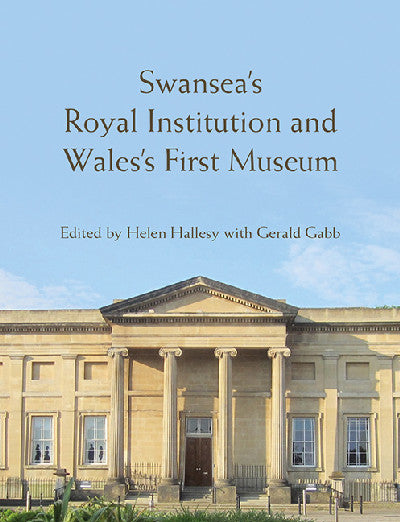
Swansea's Royal Institution and Wales's First Museum
Swansea's Royal Institution and Wales's First Museum
Couldn't load pickup availability
Disgrifiad Cymraeg / Welsh Description
Yn 1841, sefydlwyd amgueddfa gyntaf Sefydliad Brenhinol De Cymru yn Abertawe. Yn y gyfrol hon, mae awduron arbenigol yn disgrifio dechreuadau'r sefydliad fel cymdeithas ddysgedig, a'i oroesiad hyd at ddechrau'r unfed ganrif ar hugain. Mae'r gyfrol, sydd wedi'i darlunio'n gyfoethog drwyddi, yn datgelu'r casgliadau amrywiol a chynhwysfawr o fewn amgueddfa Abertawe.
Disgrifiad Saesneg / English Description
In 1841, the Royal Institution of South Wales founded the first museum in Wales. Specialist authors describe its formation as a learned society, and its survival into the twenty-first century. Lavishly illustrated throughout, the book reveals the varied and comprehensive collections within Swansea museum.
Dosbarthu
Byddwn yn dosbarthu eitemau sydd mewn stoc o fewn 3 diwrnod gwaith, fel arfer drwy Royal Mail Tracked 48. Ar gyfer archebion o flaen llaw, byddwn yn dosbarthu’r eitem o fewn 3 diwrnod gwaith ar ôl ei derbyn gan ein cyflenwr.
Dispatch
In-stock items will be dispatched within 3 business days, usually by Royal Mail Tracked 48. For pre-orders, we’ll dispatch within 3 business days of receiving the item from our supplier.
Manylion y cynnyrch / Product details
- ISBN 13
- 9781837720903
- Gwales Code
- gwales.com.9781837720903
- Gwerthwr / Vendor
- Cyngor Llyfrau Cymru
- Long Title
- Swansea's Royal Institution and Wales's First Museum
- Awdur / Author
- Press, Gwasg Prifysgol Cymru / University of Wales
- Current Price ex VAT
- £45.00
- Current Price inc VAT
- £45.00
- Availability Status (EN)
- Available
- Availability Status (CY)
- Ar gael
- Dyddiad cyhoeddi / Publication Date
- 2024-02-08
- Cyhoeddwr / Publisher
- Gwasg Prifysgol Cymru / University of Wales Press
- Editor
- Hallesy, Helen; Gabb, Gerald
- Media Type (EN)
- Hardback
- Media Type (CY)
- Clawr caled
- Pages
- 616 pages
- Size
- 189 × 246 mm; depth 15 mm
- Language Code
- English
- Categori / Category
- CY: Hanes, Hanes Lleol, Arferion Gwlad, Llên Gwerin (yn Saesneg) | EN: History, Welsh Life and Customs, Local History, Folk Tales (in English)
- Is-gategori / Subcategory
- CY: Hanes - Arall (yn Saesneg) | EN: History - Other (in English)
Cynnwys / Table of Contents
Notes on Contributors Acknowledgements Preface Lyndon Morris Introduction Jenny Sabine PART 1 Chapter 1 The Swansea Context Louise Miskell PART 2 Foundations and Early Period Chapter 2 Beginnings 2.1 Origins and Ambitions Karmen Thomas 2.2 The BAAS meeting 1848 John Tucker 2.3 The Role of Women in the RISW Jenny Sabine 2.4 The Lectures Programme Gerald Gabb and Helen Hallesy 2.5 Education 1835-1939 Gerald Gabb Chapter 3 Swansea Museum 3.1 Planning and funding the building Helen Hallesy 3.2 Uses of building and extensions Gerald Gabb PART 3 The Collections Chapter 4 Sciences Introduction Iwan Morus 4.1 Geology Ronald Austin 4.2 Botany Kevin Davies 4.3 Other Natural Sciences Emma Williams 4.4 Photography Katy Williams Chapter 5 Artefacts and Records 5.1 The Archives Andrew Dulley 5.2 The Library Gerald Gabb 5.3 Maps and Charts Phil Treseder 5.4 Local Historians Gerald Gabb 5.5 Art Helen Hallesy 5.6 Ceramics Helen Hallesy 5.7 Archaeology Gerald Gabb 5.8 Egyptology Caroline Graves-Brown 5.9 Numismatics Alan and Noel Cox 5.10 Costume Deborah Griffiths 5.11 Miscellaneous Phil Treseder PART 4 Later developments Chapter 6 Introduction Elizabeth Belcham 6.1 The Museum during WW2 Helen Hallesy 6.2 The transfer to Swansea University Syd Howells 6.3 Swansea University to Swansea City Council Iwan Davies 6.4 Education post 1939 Gerald Gabb Chapter 7 Associated Societies Introduction Gerald Gabb and Helen Hallesy 7.1 Swansea Farmers Club Helen Hallesy 7.2 Musical Groups Gerald Gabb 7.3 Literary and Scientific Society Gerald Gabb 7.4 Swansea Astronomical Society Helen Hallesy 7.5 Swansea Geological Society Helen Hallesy 7.6 Swansea Scientific Society Gerald Gabb 7.7 Field Naturalists Society Gerald Gabb 7.8 Swansea Photographic Association Helen Hallesy 7.9 Welsh Society Gerald Gabb 7.10 Philatelic Society Helen Hallesy 7.11 Shiplovers’ Society Helen Hallesy 7.12 Gower Society Ruth and Malcolm Ridge 7.13 Swansea Little Theatre Eryl Jenkins and Dave Taylor 7.14 Gower Ornithological Society Gerald Gabb List of RISW Presidents 1835-2022 Bibliography List of Subscribers Index
Bywgraffiad yr Awdur / Author Biography
Helen Hallesy is a science graduate and independent researcher on the history of the south Wales ceramic industries, focusing primarily on Swansea. She is the author of several books and articles on the subject, most recently publishing 'Swansea Commemorative Pottery' (2017). She is a long-standing Council member and Honorary Vice President of RISW. Gerald Gabb taught History before becoming education officer for Swansea Museums Service. He is a RISW Council member and, since 2009, editor of the Swansea History Journal / Minerva. He has written extensively on the locality, most recently publishing Swansea and its History, II, The Riverside Town (2019).
Adolygiad y Cyhoeddwr / Publisher Review
The Royal Institution of South Wales, founded by prominent local antiquary George Grant Francis (1814–82) and others, has a long history dating back to 1835. It received its prestigious royal charter from Queen Victoria three years later, and is still thriving as a centre of culture and original research. It has a good claim to be the oldest voluntary association in Wales with a continuous existence. The collections are large (about 100,000 items), rich and varied. They include an Egyptian mummy; prehistoric, Roman and medieval finds; paintings and drawings; vehicles and boats; and many ephemera. It ran its own museum from 1841 until 1990 when ownership was formally transferred to the City and County of Swansea. Its original objectives were: 'the Cultivation and Advancement of the various Branches of Natural History, as well as the Local History of the Town and Neighbourhood, the Extension and Encouragement of Literature and the Fine Arts, and the General Diffusion of Knowledge'. This comprehensive study, richly illustrated throughout, penned by twenty-five established scholars in various academic disciplines, tells the whole story in depth and impressive detail. It charts the growth of the institution, the contribution of some of its more prominent and influential members, and the difficulties and obstacles which have hindered its progress through the years. Among the many involved themes tackled here are the local background at Swansea (Part 1), the evolving role of women within an institution originally depicted as the preserve of menfolk, the development of an impressive lecture programme, its commitment to providing education, and the designing and expansion of the extensive museum building (Part 2). Part 3 considers the various collections acquired over the years. These spanned geological exhibits, botanical specimens, material from natural history, and the superb, ever growing photographic collections. Subsequent chapters are devoted to the archival material collected, the central role of the library, the cartographical holdings, and the so-called decorative arts – ceramics among them – represented within the prestigious Institution. Subsequent sections consider archaeological remains, coins, costumes and various other miscellanea. Themes outlined from the more modern period encompass the museum's difficult fate during the years of the Second World War, its relationship from 1920 with the University College of Swansea, and the details of its eventual transfer to Swansea City Council. In a series of chapters Gerald Gabb tackles the question of the Institution's relationship with a number of other bodies, among them the Swansea Farmers' Club, various local musical groups, the Swansea Welsh society and other local bodies. In a parallel series of linked contributions Helen Hallesy considers the Swansea Farmers’ Club and an array of other local bodies and groups. The list of past presidents of the Institution contains an array of well-known names. The first is Lewis Weston Dillwyn, president from 1836 to 1856. Other familiar names listed here include Henry Hussey Vivian, 1858–59, Henry Austin Bruce, Baron Aberdare, 1863–64, Sir Alfred Mond, Baron Melchett, 1914–16, and George Arbour Stephens, 1942–43. The bibliography and index have been meticulously prepared, and the list of subscribers, both individuals and institutions, bear testimony to the respect and affection in which the Institution is held to this day. In 2018 the Council of the Royal Institution of South Wales, which helps to support Swansea Museum, asked a small group of members to think about how the Museum might grow in the future. Its report is currently under active discussion.
Share